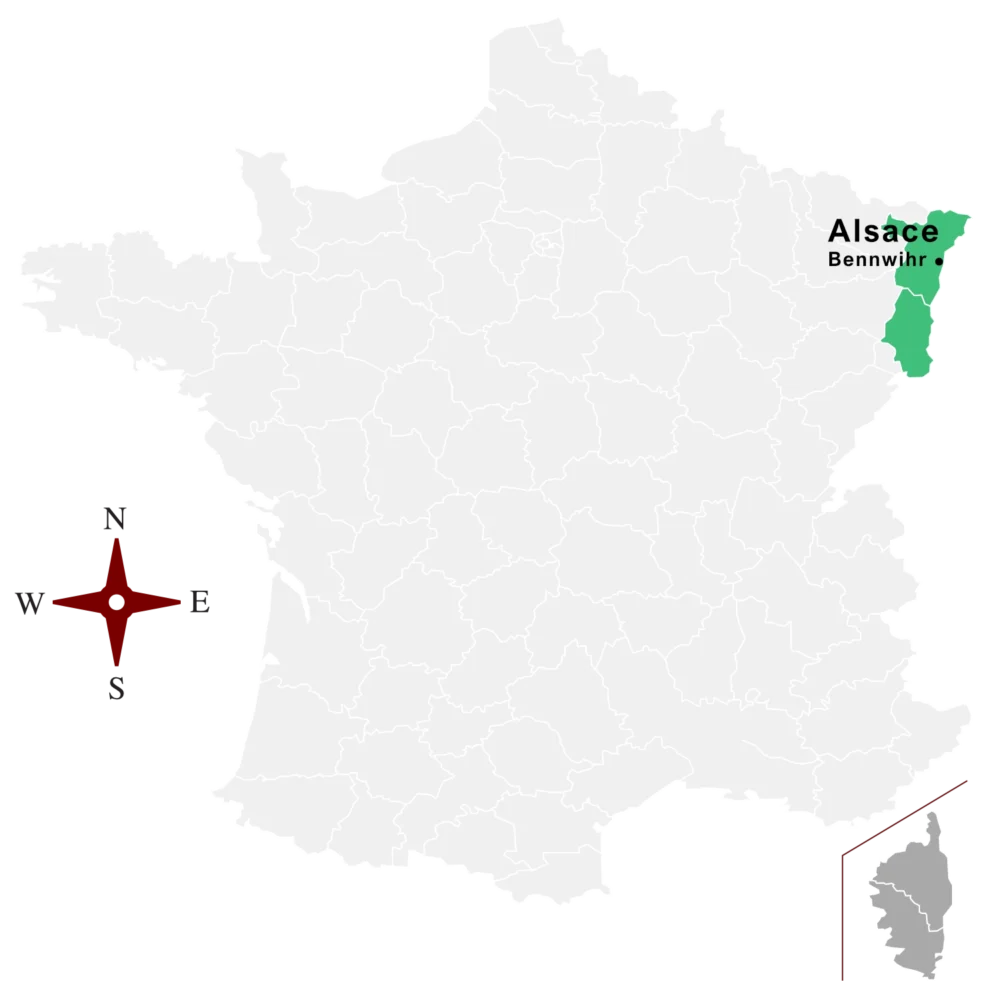
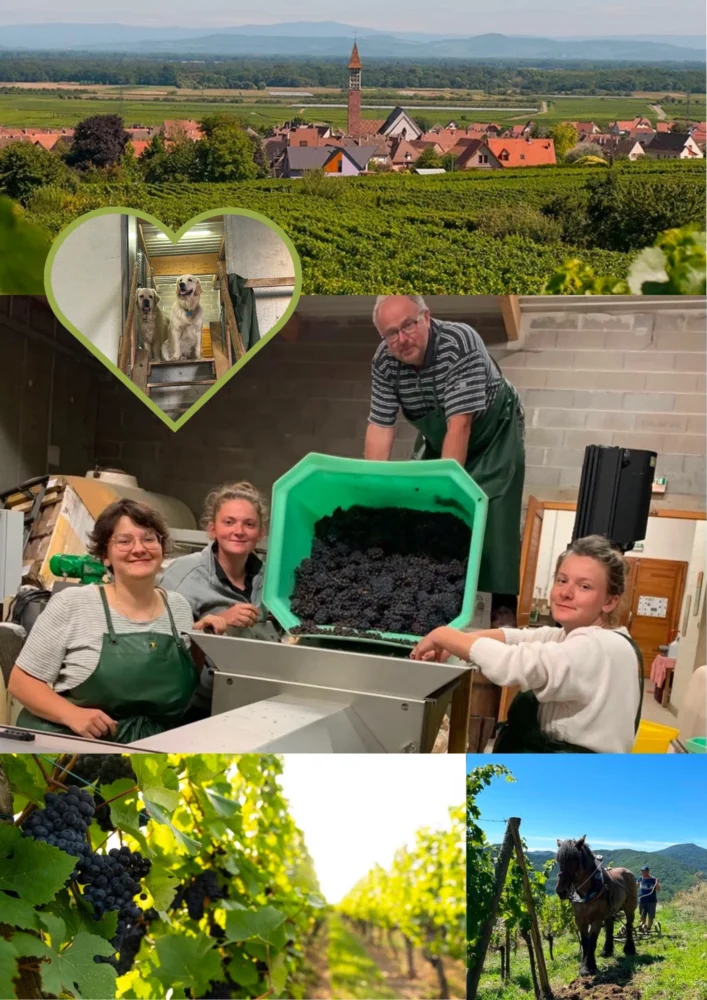
The Fonné family’s independent viticultural history dates back to 1747. Today, the family farms 17 hectares in the Haut Rhin in the heart of the Kaysersberg Valley in Alsace. With a strong family heritage, the past seven generations have been continuing Alsatian traditions while integrating contemporary approaches to winemaking; enabling each wine to reflect the unique characteristics of its terroir all at their domaine in Bennwihr.
The patriarch, Michel Fonné, has been the lead oenologist at the estate since 1989, but now works alongside his three daughters: Déborah the viticulturist, Sarah, oenologist working alongside Michel and Salomé, the youngest, who promotes the estate overseas. The two other family members are hard at work in the vineyards are Muscat and Ottonel, the resident vineyard dogs.
Bennwihr is on the Alsace Wine Route between Kaysersberg and Ribeauvillé . The oldest designations of the village date back to the year 777 under the name of Bebonisvillare. However, the origins go back to the time of the Romans with in particular the construction of the Roman road which still exists today. Nestled in the foot of the Vosges, the vineyards are made up of a mosaic of terroirs.
The landscape is composed of a succession of hills between 200 and 400m of altitude. For the past few years, the domaine has been working on 3 different locations: Rebgarten meaning “Garden of Grapes”, Roemerberg meaning “The Hill of the Romans and Vogelgarten “Bird Garden”. The unique microclimates of the region are due to its geographical orientation between the Black Forest to the east and the Vosges to the west. Never ploughing between rows, inviting biodiversity to flourish and only using indigenous yeasts, a longtime ethos of the winery pioneered by Déborah, became an official organic certification in 2022. A family member who is long passed on but contributed immensely to the region was Michel Fonné’s great uncle Barth René, who brought cuttings from Burgundy and was the first to plant Pinot Noir vines in the village.
A territory shared between France and Germany for hundreds of years, Alsace is a region with bicultural people: Charlemagne’s Frankish Empire, conquest of Louis XIV, annexation to Germany with the Treaty of Frankfurt. At the end of World War II, the liberation of Alsace was preceded by a scene of brutal violence; resulting in the death of hundreds of people and the complete destruction of some villages. Bennwihr was all but leveled with the exception of a few cemetery statues and the steeple of the town church; proudly depicted on the label and whose hourly chimes are the heartbeat of the village.